
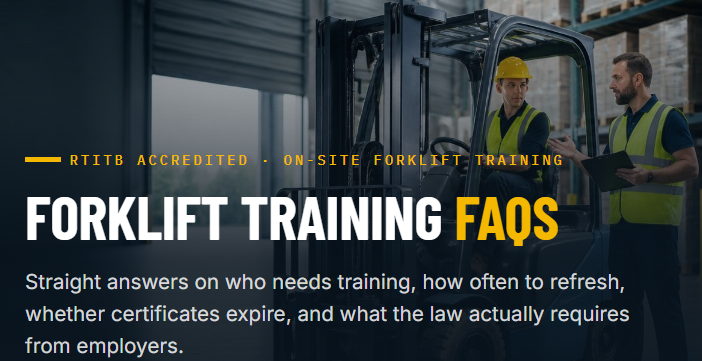
FAQs
Do I legally need training to operate a forklift?
Yes. Employers must ensure that anyone operating a forklift has received adequate training and is competent to use the equipment safely. The Health & Safety at Work Act 1974 (HSAWA-74) & The Provision of Work Equipment regulations 1998 (PUWER-98), requires appropriate training in the safe use of work equipment.
The Approved Code of Practice for Rider Operator Lift Trucks L117 states that equipment training should cover 3-elements of basic training, specific job training, and familiarisation in the workplace. An employer should not simply allow an untrained employee to operate a forklift because they have previous experience.
________________________________________________________________________________________
How often do I need forklift refresher training?
There is no fixed statutory expiry period for forklift refresher training.
The HSE recommends that employers consider refresher training at intervals of around 3–5 years, depending on the risks, while recognising that additional training may be needed sooner.
Refresher training may be appropriate after:
- An accident or near miss
- A significant period without operating a forklift
- Unsafe operating practices
- Changes to the workplace or working methods
- Changes to the equipment being used
- A change in the operator’s responsibilities or circumstances
_________________________________________________________________________________________
Does a forklift certificate/licence expire?
No, there is no government-issued forklift licence that expires.
A forklift training certificate is evidence that training has been completed; it is not the equivalent of a DVLA driving licence. HSE states that there is no such thing as a lift-truck licence.
However, employers remain responsible for ensuring operators remain competent. Refresher training or reassessment may therefore be necessary.
__________________________________________________________________________________________
What type of forklift training course do I need?
Novice training is for someone with little or no relevant forklift experience.
Experienced-operator training is intended for someone who has previously operated forklifts but needs formal training and certification.
Refresher training updates an existing operator’s knowledge and skills and addresses unsafe practices or gaps in competence.
Conversion training is for an already trained operator who needs to operate a different type of forklift or handling equipment.
____________________________________________________________________________________________
How long does forklift training take?
It depends on the operator’s previous experience, the truck type and the scope of training required.
Typical industry accredited courses are approximately:
- Novice operator: 3–5 days
- Experienced operator: around 2–3 days
- Refresher: 0.5 to 1 day
- Conversion: typically1–2 days, depending on the equipment
____________________________________________________________________________________________
Do I need a car driving licence to operate a forklift?
No, not when operating a forklift in the workplace.
A normal UK car driving licence is not a legal prerequisite for workplace forklift operation.
However, if the forklift is to be driven on a public road, additional road-traffic requirements may apply.
____________________________________________________________________________________________
Is forklift training theory as well as practical?
Yes. Operator training should address both theoretical knowledge and practical operation.
Training typically covers subjects such as:
- Forklift stability
- Controls and instrumentation
- Load handling
- Pre-use checks
- Safe operating procedures
- Workplace hazards
- Loading and unloading
- Stacking and de-stacking
- Pedestrian safety
- Relevant legislation and responsibilities
______________________________________________________________________________________________
Can forklift training be carried out at my workplace?
Yes. Gillick Industrial Training offers on-site training, provided the workplace has suitable facilities, equipment, and conditions for safe training.
On-site training can be particularly useful because the operator can receive familiarisation on the actual equipment, working environment, routes, loads, and workplace hazards.
The on-site training we provide on you site is in accordance with The Approved Code of Practice for Rider Operator Lift Trucks L117.
_____________________________________________________________________________________________
Do I have to wear a seat belt when operating a forklift?
Where a forklift is fitted with a seat belt or restraint system, the operator should use it as required by the manufacturer’s instructions and workplace rules.
Employers should assess the truck and working environment and ensure operators understand the restraint system fitted to the machine.
_______________________________________________________________________________________________
Can forklifts be driven on public roads?
Sometimes, but workplace forklift training alone does not automatically make a forklift road legal.
When a forklift is used on a public highway, the relevant road-traffic legislation and requirements apply. This is different from simply operating a forklift on private workplace premises.
HSE confirms that a road-driving licence is not normally required for workplace plant, but additional requirements apply when plant is operated on public roads.
Before taking a forklift onto a public road, the operator/employer should establish the applicable vehicle, registration, taxation, insurance, lighting, roadworthiness and driving-licence requirements for that machine and use.
_______